HomeBlogsBuilding Scalable APIs with Node.js and Express
Web Development Backend Engineering Software Architecture
Building Scalable APIs with Node.js and Express
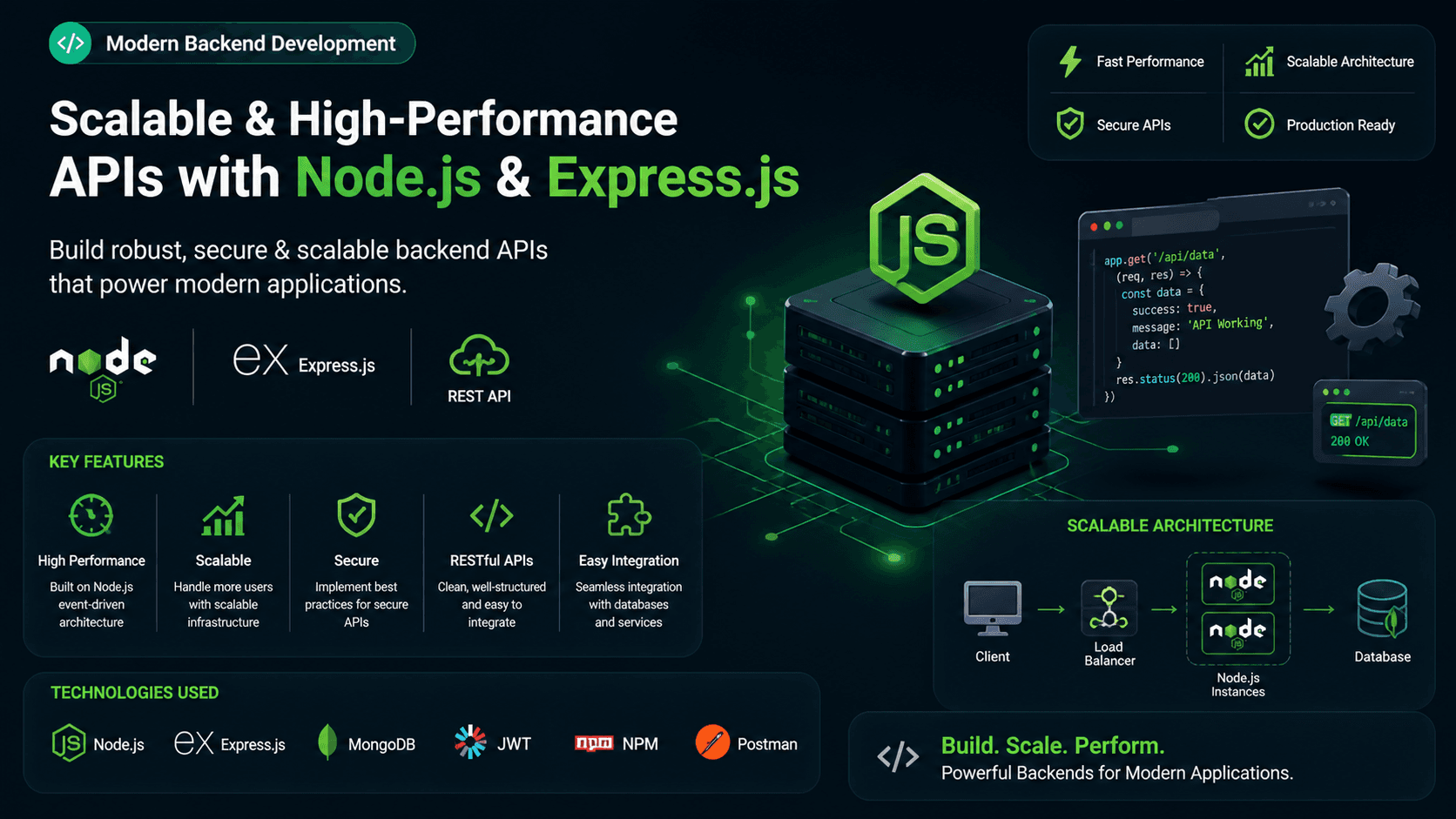
This article explores strategies for building scalable APIs using Node.js and Express. It covers why Node.js and Express are suitable for scalability, outlines core design principles like statelessness and horizontal scaling, and provides practical techniques such as Node.js clustering and implementing caching. The goal is to equip developers with knowledge to create high-performance APIs that grow with their applications.
Platform Admin
May 3, 2026
6 min read
45 views
Building Scalable APIs with Node.js and Express
In today's interconnected digital landscape, robust and scalable APIs are the backbone of almost every successful application. As user bases grow and data volumes surge, an API's ability to handle increased load without compromising performance becomes paramount. Node.js, with its event-driven, non-blocking I/O model, combined with the lightweight and flexible Express.js framework, offers a powerful platform for constructing high-performance, scalable backend services.
This article explores key strategies and best practices for building APIs that can effortlessly scale alongside your application's growth, leveraging the strengths of Node.js and Express.
Why Node.js and Express for Scalability?
Node.js is renowned for its efficiency in handling concurrent requests. Its single-threaded, asynchronous nature means it doesn't create a new thread for every client request, leading to lower memory consumption and faster context switching compared to traditional multi-threaded servers. Express.js, as a minimalist web framework, provides the necessary tools for routing, middleware, and request handling without imposing heavy architectural constraints, allowing developers to build highly optimized and custom solutions.
Key advantages include:
Non-blocking I/O: Ideal for data-intensive real-time applications, ensuring the server remains responsive even during lengthy operations like database queries or external API calls.
Achieving scalability isn't just about the technology stack; it also requires adherence to fundamental design principles:
1. Statelessness
Design your API endpoints to be stateless. Each request from a client to the server should contain all the information needed to understand the request. The server should not store any client context between requests. This makes it easier to distribute requests across multiple servers and allows for seamless horizontal scaling.
2. Asynchronous Operations
Embrace asynchronous programming patterns for all I/O operations (database calls, file system operations, network requests). Node.js naturally excels here. Utilize
code
async/await
for cleaner, more readable asynchronous code, avoiding callback hell and improving maintainability.
3. Horizontal Scaling
Instead of building a single, powerful server (vertical scaling), distribute the load across multiple, less powerful servers (horizontal scaling). This involves:
Clustering: Node.js's built-in
code
cluster
module allows you to fork multiple worker processes that share the same server port, effectively utilizing multi-core CPUs.
Load Balancing: Deploy a load balancer (e.g., a reverse proxy) in front of your Node.js application instances to distribute incoming traffic evenly, preventing any single instance from becoming a bottleneck.
4. Database Optimization
The database is often the first bottleneck in a scalable application. Strategies include:
Efficient Queries: Optimize SQL queries, use appropriate indexes, and avoid N+1 query problems.
Connection Pooling: Manage database connections efficiently to reduce the overhead of establishing new connections for every request.
Database Sharding/Replication: Distribute data across multiple database servers or use read replicas to scale read operations.
5. Caching
Implement caching at various levels to reduce the load on your database and speed up response times for frequently requested data:
Client-side Caching: Use HTTP caching headers (e.g.,
code
Cache-Control
,
code
ETag
) to allow clients to cache responses.
Server-side Caching: Store frequently accessed data in a fast, in-memory store (e.g., a distributed cache system) before it hits the database.
CDN: Utilize Content Delivery Networks for serving static assets.
6. Rate Limiting
Protect your API from abuse, excessive requests, and potential denial-of-service attacks by implementing rate limiting. This ensures fair usage and prevents a single client from monopolizing server resources. Middleware can easily implement this in Express.
7. Modular and Microservice Architecture (Optional)
For very large applications, consider breaking down your monolithic API into smaller, independent services (microservices). Each service can be developed, deployed, and scaled independently, offering greater flexibility and resilience. Express is well-suited for building individual microservices.
Practical Techniques with Node.js and Express
Node.js Clustering Example
Leverage the built-in
code
cluster
module to distribute workload across CPU cores:
code
const cluster = require('cluster');
const http = require('http');
const numCPUs = require('os').cpus().length;
const express = require('express');
if (cluster.isMaster) {
console.log(`Master ${process.pid} is running`);
// Fork workers.
for (let i = 0; i < numCPUs; i++) {
cluster.fork();
}
cluster.on('exit', (worker, code, signal) => {
console.log(`worker ${worker.process.pid} died`);
cluster.fork(); // Replace dead worker
});
} else {
// Workers can share any TCP connection
// In this case it is an HTTP server
const app = express();
app.get('/', (req, res) => {
res.send(`Hello from worker ${process.pid}`);
});
const PORT = process.env.PORT || 3000;
app.listen(PORT, () => {
console.log(`Worker ${process.pid} started on port ${PORT}`);
});
}
Efficient Middleware and Request Handling
Keep middleware lean: Only include essential logic in middleware. Heavy operations should be offloaded.
Early exit: If a request can be handled quickly, respond immediately to free up resources.
Payload validation: Validate incoming request bodies early to prevent unnecessary processing of invalid data.
For server-side caching, integrate a distributed cache. For example, a simple in-memory cache could be:
code
const NodeCache = require('node-cache'); // A common in-memory cache package
const myCache = new NodeCache({ stdTTL: 60 * 5, checkperiod: 60 * 10 }); // 5 min TTL
app.get('/cached-data/:id', async (req, res, next) => {
const key = req.params.id;
const cachedData = myCache.get(key);
if (cachedData) {
console.log('Serving from cache');
return res.json(cachedData);
}
try {
const freshData = await fetchDataFromDatabase(key);
myCache.set(key, freshData); // Cache the fresh data
res.json(freshData);
} catch (error) {
next(error);
}
});
Conclusion
Building scalable APIs with Node.js and Express is achievable by combining the platform's inherent strengths with sound architectural principles and practical techniques. By focusing on statelessness, asynchronous operations, horizontal scaling, robust caching, and efficient resource management, developers can create high-performance APIs capable of meeting the demands of modern applications and growing user bases. The journey to a truly scalable API is iterative, requiring continuous monitoring, profiling, and optimization, but with Node.js and Express, you have a powerful foundation to start from.
References
(No external references were used for specific facts or data requiring citation in this article, as the content focuses on general best practices and conceptual explanations derived from common software engineering knowledge.)
Node.js Express.js API Development Backend Scalability Performance Optimization Web Development Architecture
Share this post:
Comments (0)
No comments yet. Be the first to comment!
Technology
The Future of AI in Web Development: A Comprehensive Guide
This guide explores how artificial intelligence is reshaping web development through automated coding, personalized user experiences, and enhanced testing protocols. It examines the transition of developers from coders to technical architects in an increasingly automated landscape.
5/6/2026 5 min
Scalable APIs with Node.js & Express: A Comprehensive Guide | TechUpdatesZone Blog